



With the residential federal solar tax credit no longer available, many Massachusetts homeowners are wondering whether going solar still makes financial sense.
Purchasing a solar energy system outright or financing it with a traditional loan may still be the best choice for some homeowners. However, without the residential tax credit, these options may require a larger net investment than they once did.
That’s where Propel comes in.
New England Clean Energy is excited to offer Propel to eligible Massachusetts homeowners. This innovative solar financing option can make it possible to install solar with little or no upfront cost while providing a clear path toward owning your solar energy system.
Propel also offers homeowners another way to benefit from available solar incentives.
Because Propel owns the system during the initial agreement period, it may use available commercial tax incentives. The value of those incentives is then incorporated into the program’s pricing rather than claimed directly by the homeowner.
In many cases, this structure may result in an overall cost that is 20–30% lower than traditional purchase options. Actual pricing and savings will vary based on the home, system, eligibility, financing terms, and other factors.
For homeowners looking for a more flexible and affordable way to go solar in today’s market, Propel may be exactly what they have been waiting for.
What Is Propel?
Propel is a different approach to solar financing.
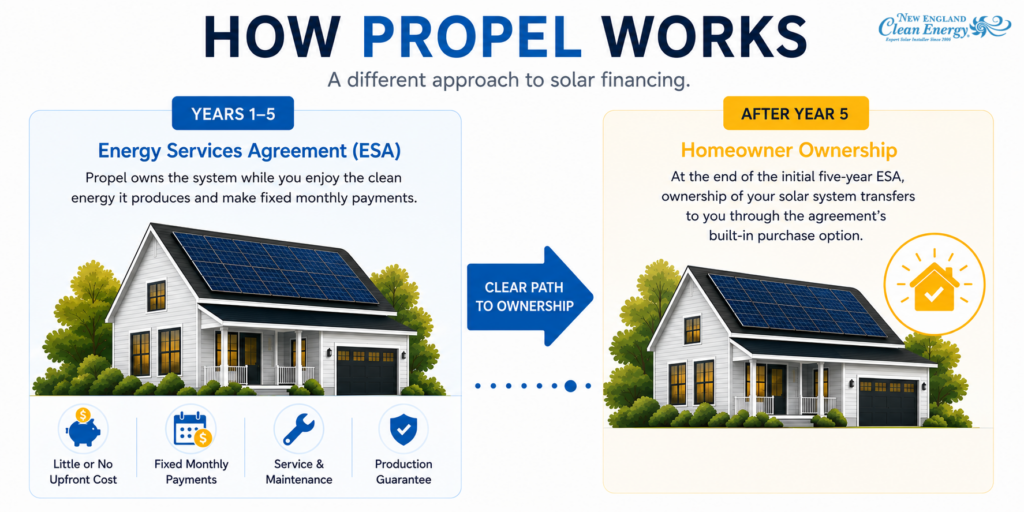
Instead of purchasing your solar system immediately, you begin with a five-year Energy Services Agreement, or ESA. During this period, Propel owns the equipment while you use the clean electricity it produces and make fixed monthly payments.

Rather than claiming a residential federal solar tax credit yourself, you benefit indirectly through the structure and pricing of the Propel program.
At the end of the initial five-year ESA, ownership of the solar system transfers to you through the agreement’s built-in purchase option, provided you have fulfilled the terms of the agreement.
Unlike many traditional solar leases, Propel is designed with eventual homeowner ownership in mind from the beginning.
During the first five years, Propel provides:
- Little or no upfront installation cost for qualified homeowners
- Fixed monthly payments
- Professional system monitoring
- Maintenance and service coverage
- A production guarantee
- A clear path toward ownership after five years
For many homeowners, Propel provides a balance between affordability today and ownership tomorrow.
Why Propel Makes Sense Today
The residential federal solar tax credit may no longer be available, but that does not mean affordable solar has disappeared.
Propel provides another way for homeowners to benefit from the value of solar incentives. Instead of relying on the homeowner to claim a residential tax credit, Propel uses a different ownership structure during the first five years.
This allows the program to incorporate the value of available commercial incentives into its pricing.
For some homeowners, this can reduce the overall cost of going solar compared with purchasing a system outright or using traditional financing without a residential tax credit.
Propel does not replace the residential federal tax credit with a new homeowner tax credit. Instead, it provides an alternative way to capture incentive value through the program’s structure.
That distinction is important when comparing your solar financing options.
Why This Matters for Massachusetts Homeowners
Electricity costs remain a major concern for Massachusetts homeowners.
Solar can help reduce the amount of electricity you need to purchase from your utility, but the initial investment has traditionally prevented some homeowners from making the switch.
The loss of the residential federal solar tax credit may make that upfront investment feel even more challenging.
Propel gives Massachusetts homeowners another option.
Rather than waiting years to save enough for a cash purchase or taking out a traditional solar loan, eligible homeowners can begin producing clean electricity with little or no upfront cost while working toward system ownership.
For homeowners planning to remain in their homes for several years, this structure may offer an attractive alternative.
Propel vs. Traditional Solar Leases
People often hear “little or no upfront cost” and assume Propel works exactly like a traditional solar lease.
While there are some similarities, there are also important differences.

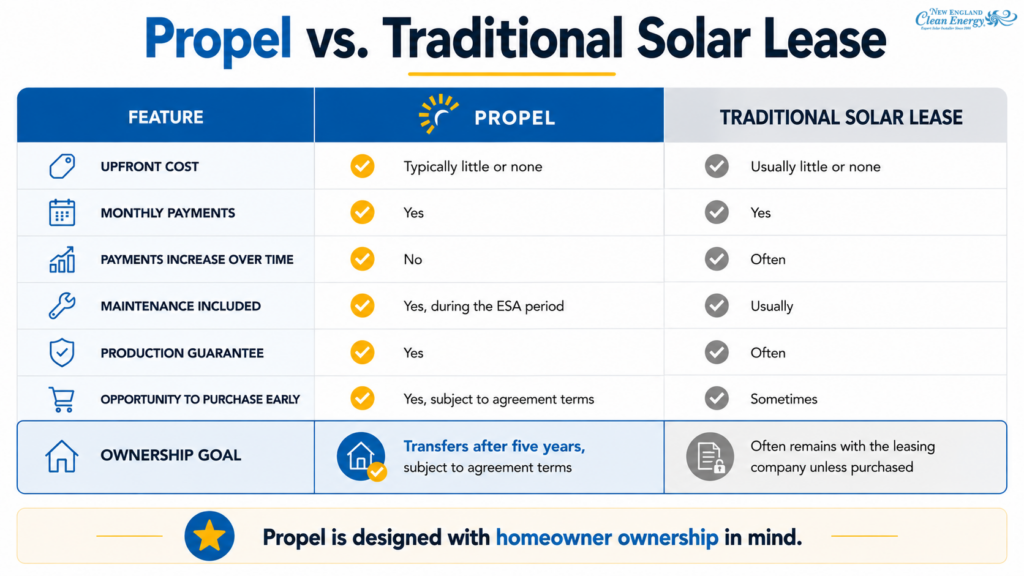
One of Propel’s biggest advantages is that it is structured to help homeowners become system owners rather than permanent lessees.
Common Questions About Propel
Will I eventually own my solar system?
Yes.
Provided you have fulfilled the terms of your agreement, ownership transfers to you for $1 after the initial five-year Energy Services Agreement.
Your individual agreement will contain the complete requirements and terms governing the ownership transfer.
Can I purchase the system sooner?
Yes.
Propel includes an early purchase option if you decide you would like to own your system before the initial five-year period ends.
The price and terms of an early purchase are governed by your Energy Services Agreement. Your New England Clean Energy representative can explain how this option works before you move forward.
Who receives the solar tax incentives?
During the initial agreement period, Propel owns the solar system and may claim available commercial tax incentives.
The homeowner does not claim those incentives directly. Instead, their value is incorporated into the structure and pricing of the Propel program.
Is Propel a replacement for the federal solar tax credit?
Not exactly.
Propel does not provide homeowners with a replacement tax credit. Instead, it offers another way to benefit from available incentive value through Propel’s initial ownership of the system.
This structure can make solar more affordable for some homeowners now that the residential federal tax credit is no longer available.
What happens if something breaks?
During the Energy Services Agreement period, Propel provides monitoring and service coverage for the solar equipment included in the agreement.
If a covered issue arises, you will have a clear process for receiving support rather than being left to determine who to call or how to arrange repairs on your own.
The specific coverage, exclusions, and service terms will be outlined in your agreement.
What if I sell my home?
Every real estate transaction is different, but homeowners may have options depending on when the home is sold and the terms of the agreement.
If you are considering selling your home in the near future, our team can explain how the Propel agreement may affect your plans before you move forward.
Will I still save money on electricity?
Every home and solar project is different.
Potential savings depend on factors such as:
- Current and future electricity usage
- Utility rates
- Roof orientation and available sunlight
- System size and expected production
- Propel payments and agreement terms
- Changes in household energy needs
During your free consultation, New England Clean Energy will provide customized estimates to help you understand the potential financial impact before making a decision.
Is Propel Right for You?

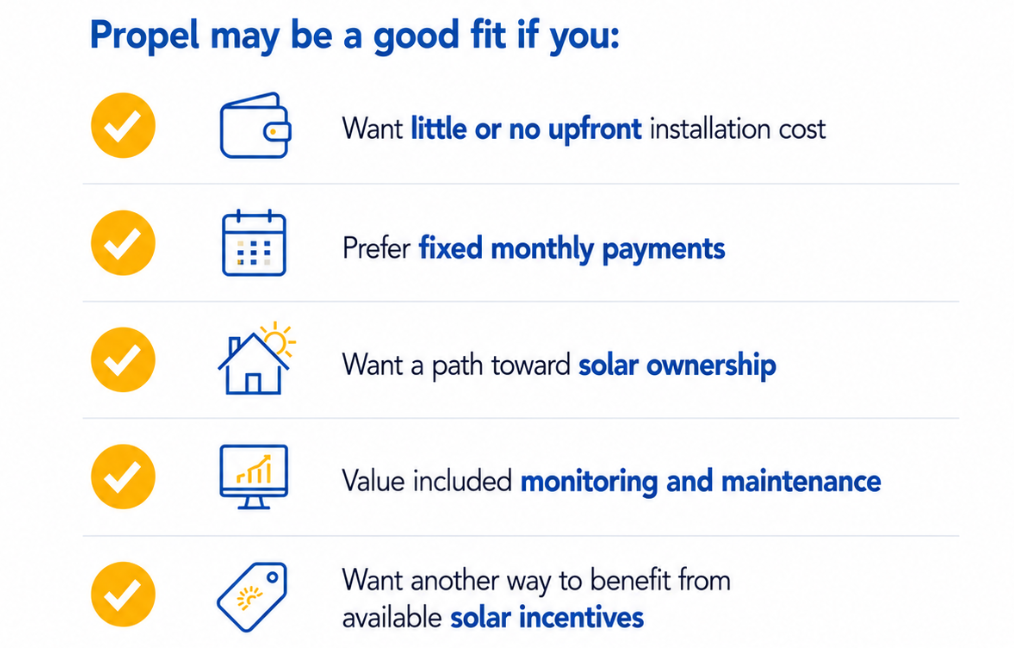
For some homeowners, purchasing a system outright or using a traditional solar loan may still provide the best long-term financial outcome.
For others, Propel may deliver a more affordable path to ownership by capturing the value of available incentives differently.
That is why New England Clean Energy helps homeowners compare their options rather than recommending a one-size-fits-all solution.
Our goal is to help you choose the approach that makes the most sense for your home, budget, energy usage, and long-term plans.
A New Path Forward for Massachusetts Solar
For years, many homeowners believed going solar required writing a large check or taking out a sizable loan.
The disappearance of the residential federal solar tax credit may have made those traditional options feel even further out of reach.
Propel provides another path.
By combining little or no upfront cost, fixed monthly payments, initial service coverage, and a straightforward path toward ownership, Propel can help eligible Massachusetts homeowners continue moving forward with solar.
Its structure also allows homeowners to benefit indirectly from available commercial tax incentives, even though they do not claim those incentives themselves.
Ready to learn more? Contact New England Clean Energy for a free consultation and see whether Propel is the right choice for your Massachusetts home.
If you liked this article, you may also like:
The Truth About “24/7 Solar Monitoring”
What Is C-PACE in Rhode Island—and How Can It Help Fund Your Commercial Energy Project?