
If your organization has been considering solar, July 4, 2026 could be one of the most important dates on your planning calendar.
Recent federal policy changes have created a significant milestone for commercial solar projects. Businesses that achieve commercial solar safe harbor status by July 4, 2026 may preserve eligibility under current federal tax credit rules and gain additional time to complete their projects.
For organizations with large energy expenses, capital improvement plans, or sustainability goals, understanding this deadline could have a meaningful impact on project economics.
What Is the July 4, 2026 Solar Deadline?
Under current federal guidance, commercial solar projects that reach Safe Harbor status by July 4, 2026 can preserve eligibility for the full 30% Federal Investment Tax Credit (ITC) under existing rules.
Perhaps even more importantly, Safe Harbor provides additional protection against delays that are often outside a project’s control.
Permitting timelines, utility interconnection reviews, equipment procurement, and construction schedules can all affect project completion dates. Safe Harbor allows organizations to move forward with greater confidence while maintaining flexibility.
What Does “Safe Harbor” Mean?
In simple terms, Safe Harbor allows a solar project to establish its eligibility under current tax credit rules before construction is complete.
Rather than requiring a project to be fully operational immediately, businesses can take specific actions that demonstrate construction has officially begun and lock in their eligibility under existing federal requirements.
This can be particularly valuable for larger commercial projects that require extensive engineering, utility coordination, financing approvals, or phased construction schedules.
How to Achieve Commercial Solar Safe Harbor Status
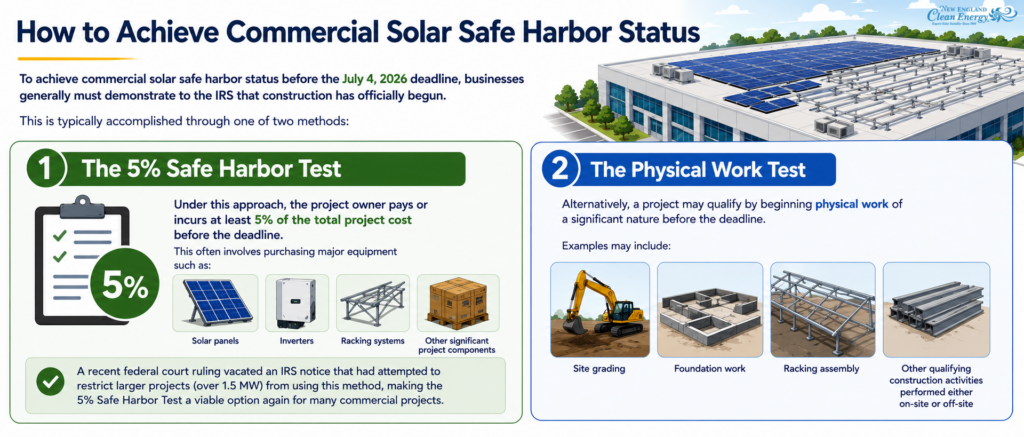
To achieve commercial solar safe harbor status before the July 4, 2026 deadline, businesses generally must demonstrate to the IRS that construction has officially begun. This is typically accomplished through one of two methods:
The 5% Safe Harbor Test
Under this approach, the project owner pays or incurs at least 5% of the total project cost before the deadline.
This often involves purchasing major equipment such as:
- Solar panels
- Inverters
- Racking systems
- Other significant project components
A recent federal court ruling vacated an IRS notice that had attempted to restrict larger projects (over 1.5 MW) from using this method, making the 5% Safe Harbor Test a viable option again for many commercial projects.
The Physical Work Test
Alternatively, a project may qualify by beginning physical work of a significant nature before the deadline.
Examples may include:
- Site grading
- Foundation work
- Racking assembly
- Other qualifying construction activities performed either on-site or off-site
Because qualification requirements can vary by project, organizations should work with experienced solar developers and tax professionals to determine the most appropriate path.
What Does Safe Harbor Give You?
One of the biggest advantages of commercial solar safe harbor is time.
Businesses that successfully Safe Harbor their projects before July 4, 2026 can bypass the December 31, 2027 completion deadline currently associated with federal tax credit eligibility.
Instead, Continuity Safe Harbor rules generally provide up to four years from the date construction begins to place the system into service while maintaining eligibility under existing tax credit rules.
For large-scale commercial projects, that additional flexibility can be incredibly valuable.
Delays Happen. Safe Harbor Helps Protect Against Them.
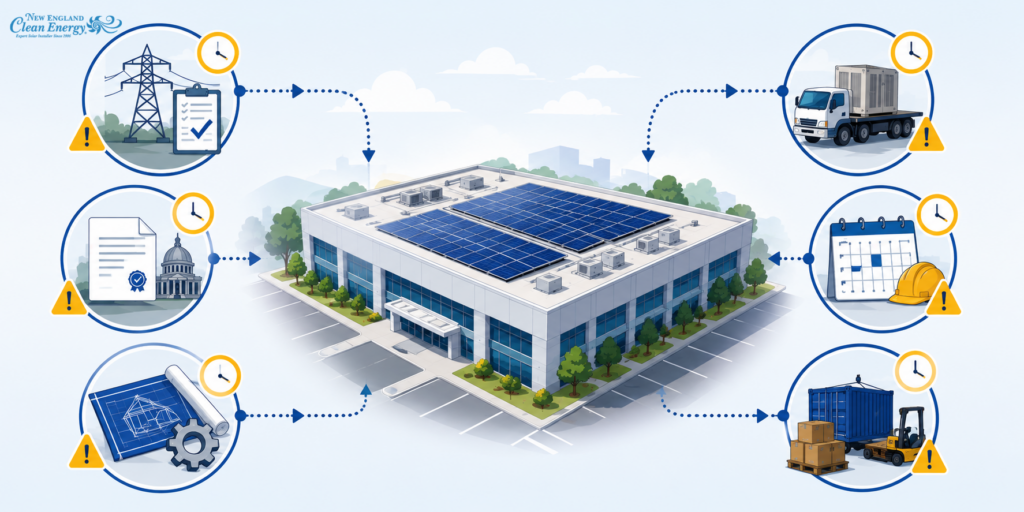
Commercial solar projects involve multiple stakeholders and approval processes.
Potential delays can include:
- Utility interconnection timelines
- Municipal permitting reviews
- Equipment procurement schedules
- Engineering and design revisions
- Construction coordination
- Supply chain disruptions
While many of these factors are impossible to predict, Safe Harbor can provide additional protection by preserving project flexibility even when timelines shift.
What About Equipment and Supply Chain Requirements?
Federal regulations surrounding equipment sourcing continue to evolve.
Organizations that establish Safe Harbor status before the July 2026 deadline may benefit from greater flexibility under current Foreign Entity of Concern (FEOC) requirements and sourcing thresholds.
As rules become more restrictive over time, early planning may provide access to a broader range of equipment and procurement options.
Should Your Business Act Now?
Not every organization is ready to install solar immediately—and that’s okay.
However, businesses that expect to explore solar within the next several years may benefit from understanding how commercial solar safe harbor could affect project economics, financing, procurement, and scheduling.
The earlier a project is evaluated, the more opportunities there are to review financing options, analyze energy savings, coordinate stakeholders, and determine whether Safe Harbor makes strategic sense.
Start the Conversation Before the Deadline Approaches
For organizations considering solar, waiting until 2026 could significantly reduce available options.
Understanding Safe Harbor requirements now can help preserve flexibility, reduce project risk, and support better long-term planning.
If your business, municipality, school, nonprofit, or commercial property is evaluating solar, New England Clean Energy can help you understand how current federal requirements may impact your project and whether a Safe Harbor strategy makes sense for your goals.
The July 2026 deadline will arrive sooner than you think. Start the conversation now to understand your options, explore commercial solar safe harbor strategies, and preserve project flexibility. Schedule a free consultation today.
If you liked this article, you may also like:
Myth vs. Reality: What Homeowners Should Know About Heat Pumps
Rhode Island Solar Incentives 2026: What Homeowners and Businesses Need to Know